Unsolved problem in mathematics For even numbers, divide by 2; For odd numbers, multiply by 3 and add 1. With enough repetition, do all positive integers converge to 1? More uns...
Worldlex WikiContenu en francaisLecture gratuite
More unsolved problems in mathematics
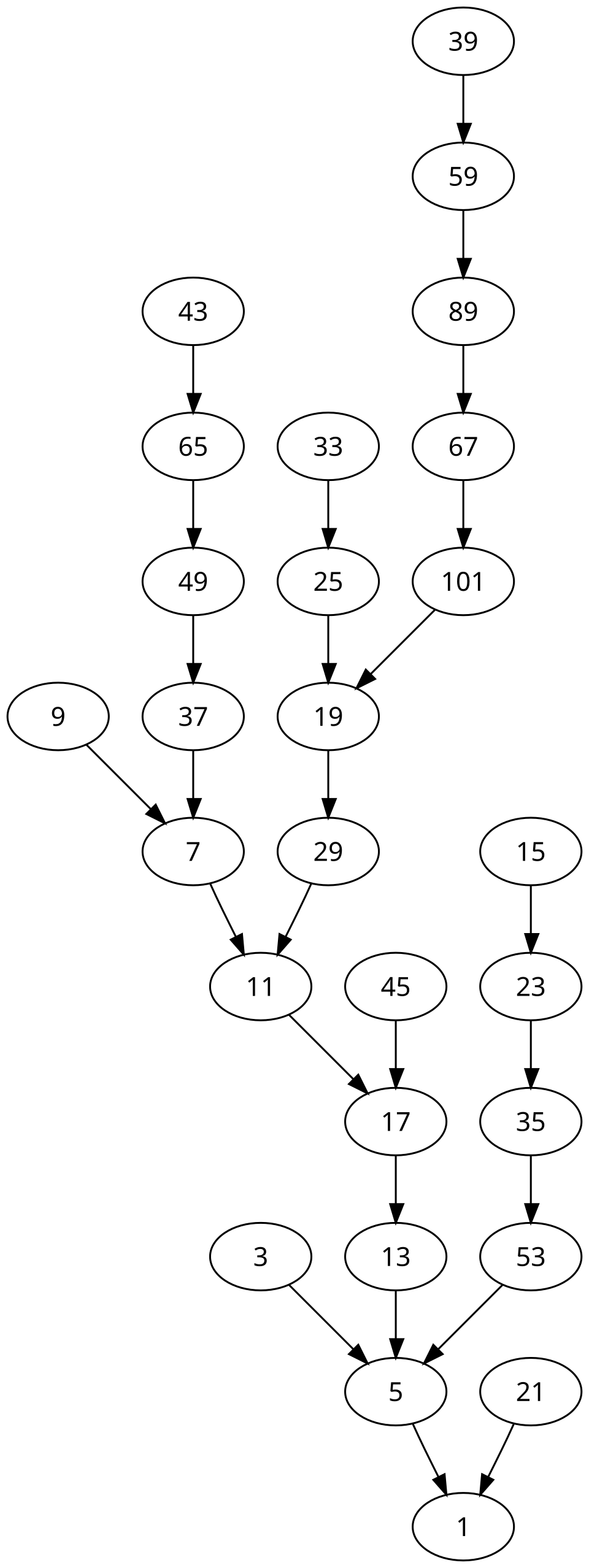
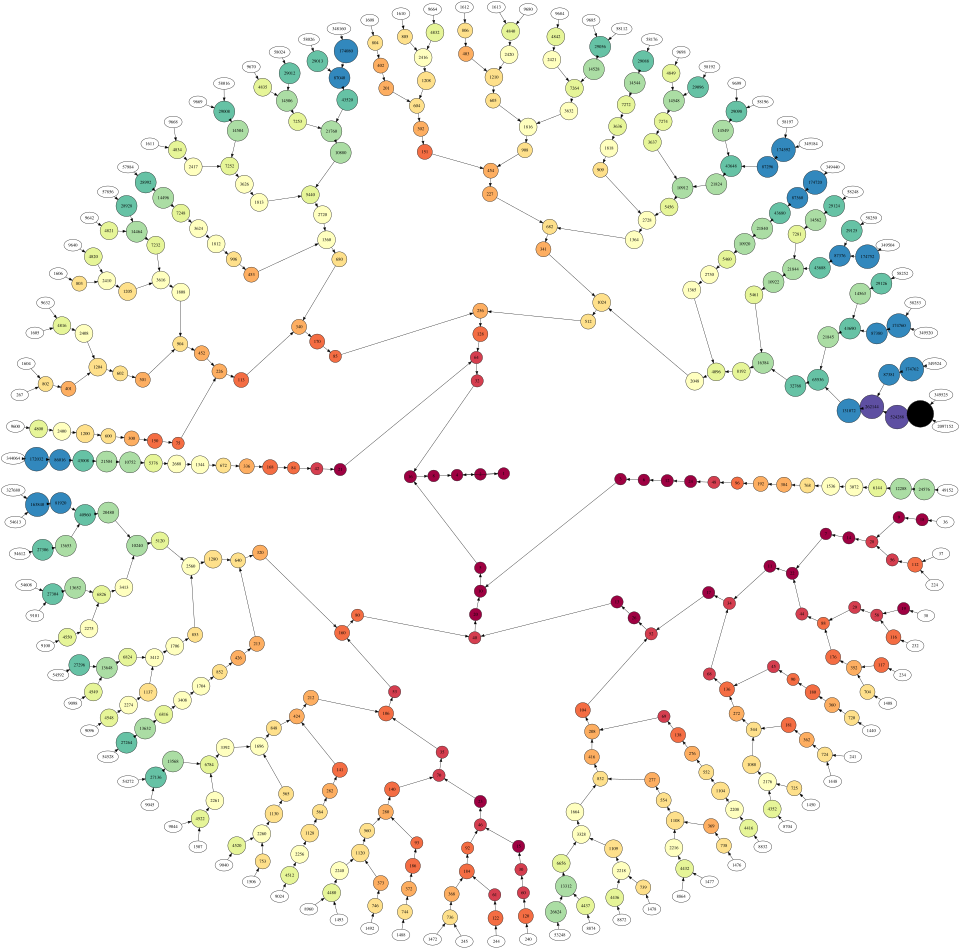
Directed graph showing the orbits of small numbers under the Collatz map, skipping even numbers. The Collatz conjecture states that all paths eventually lead to 1.
The Collatz conjecture is one of the most famous unsolved problems in mathematics. The conjecture asks whether repeating two simple arithmetic operations will eventually transform every positive integer into 1. It concerns sequences of integers in which each term is obtained from the previous term as follows: if a term is even, the next term is one half of it. If a term is odd, the next term is 3 times the previous term plus 1. The conjecture is that these sequences always reach 1, no matter which positive integer is chosen to start the sequence. The conjecture has been shown to hold for all positive integers up to Lothar Collatz, who introduced the idea in 1937, two years after receiving his doctorate. The sequence of numbers involved is sometimes referred to as the hailstone sequence, hailstone numbers or hailstone numerals (because the values are usually subject to multiple descents and ascents like hailstones in a cloud), or as wondrous numbers.
Paul Erdős said about the Collatz conjecture: "Mathematics may not be ready for such problems."Jeffrey Lagarias stated in 2010 that the Collatz conjecture "is an extraordinarily difficult problem, completely out of reach of present day mathematics". However, though the Collatz conjecture itself remains open, efforts to solve the problem have led to new techniques and many partial results.
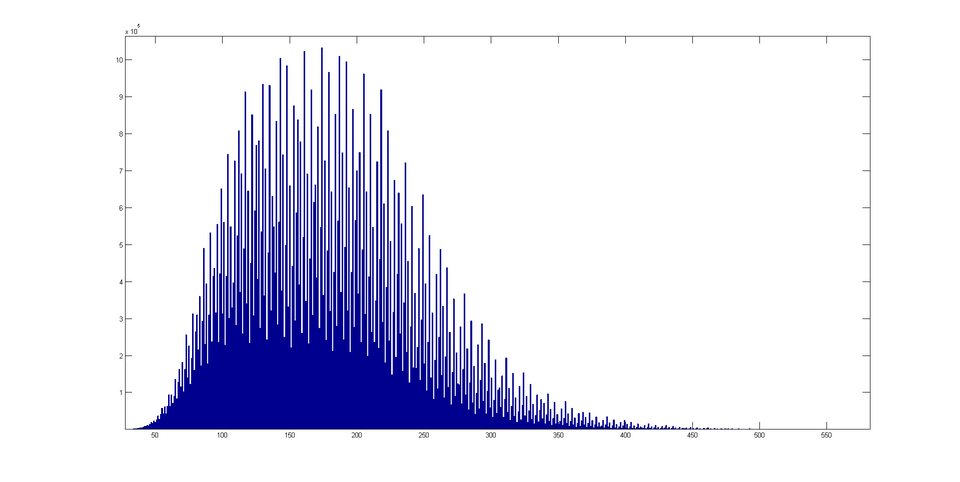
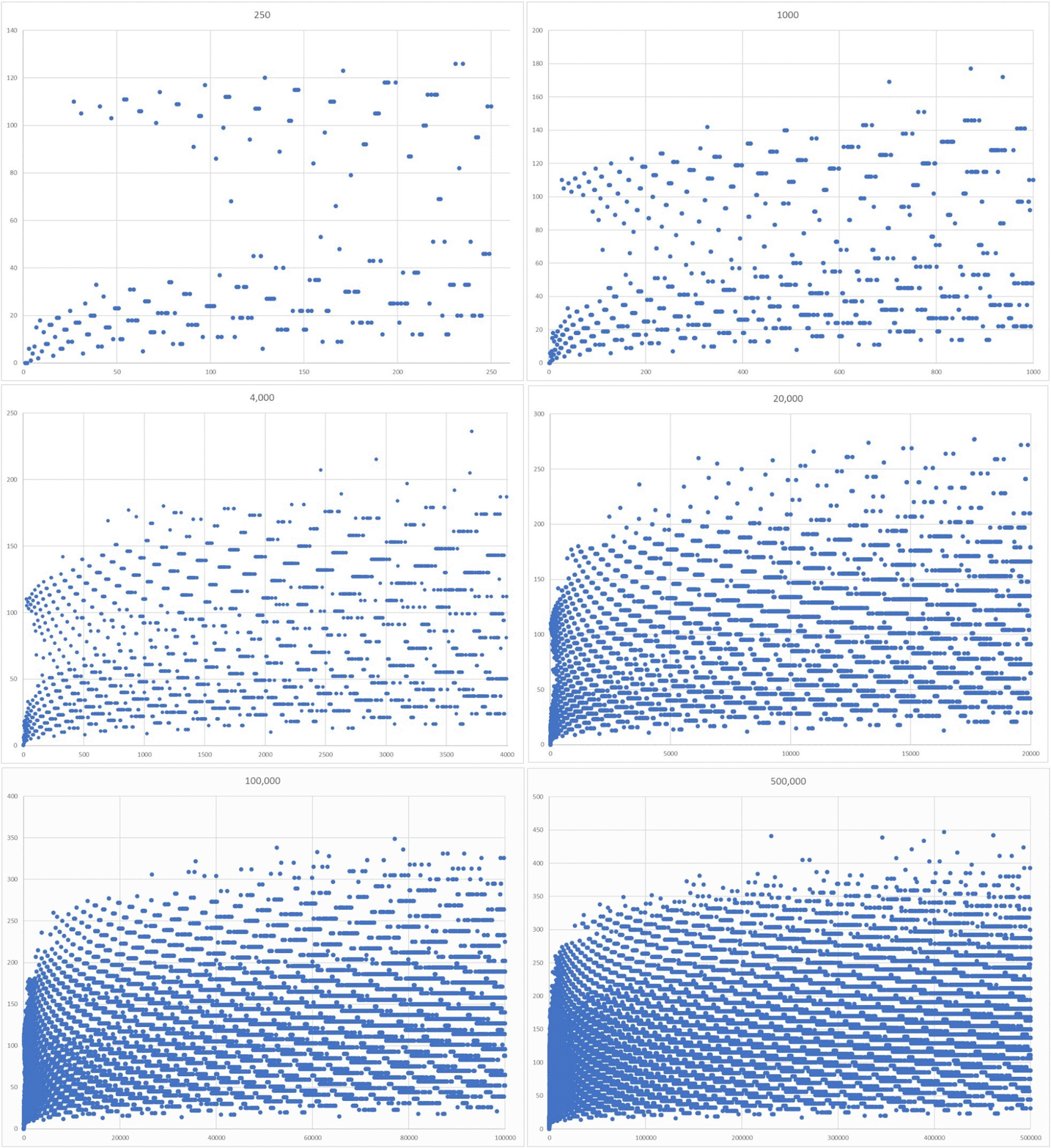
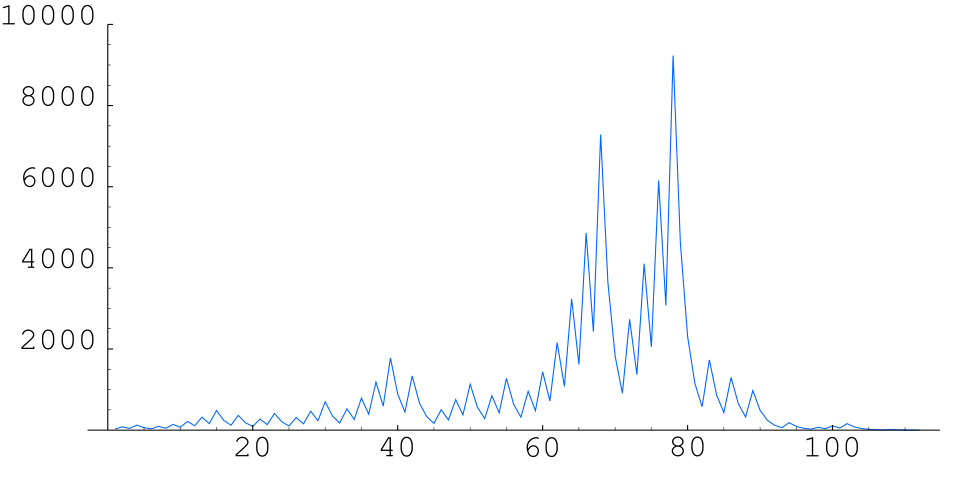
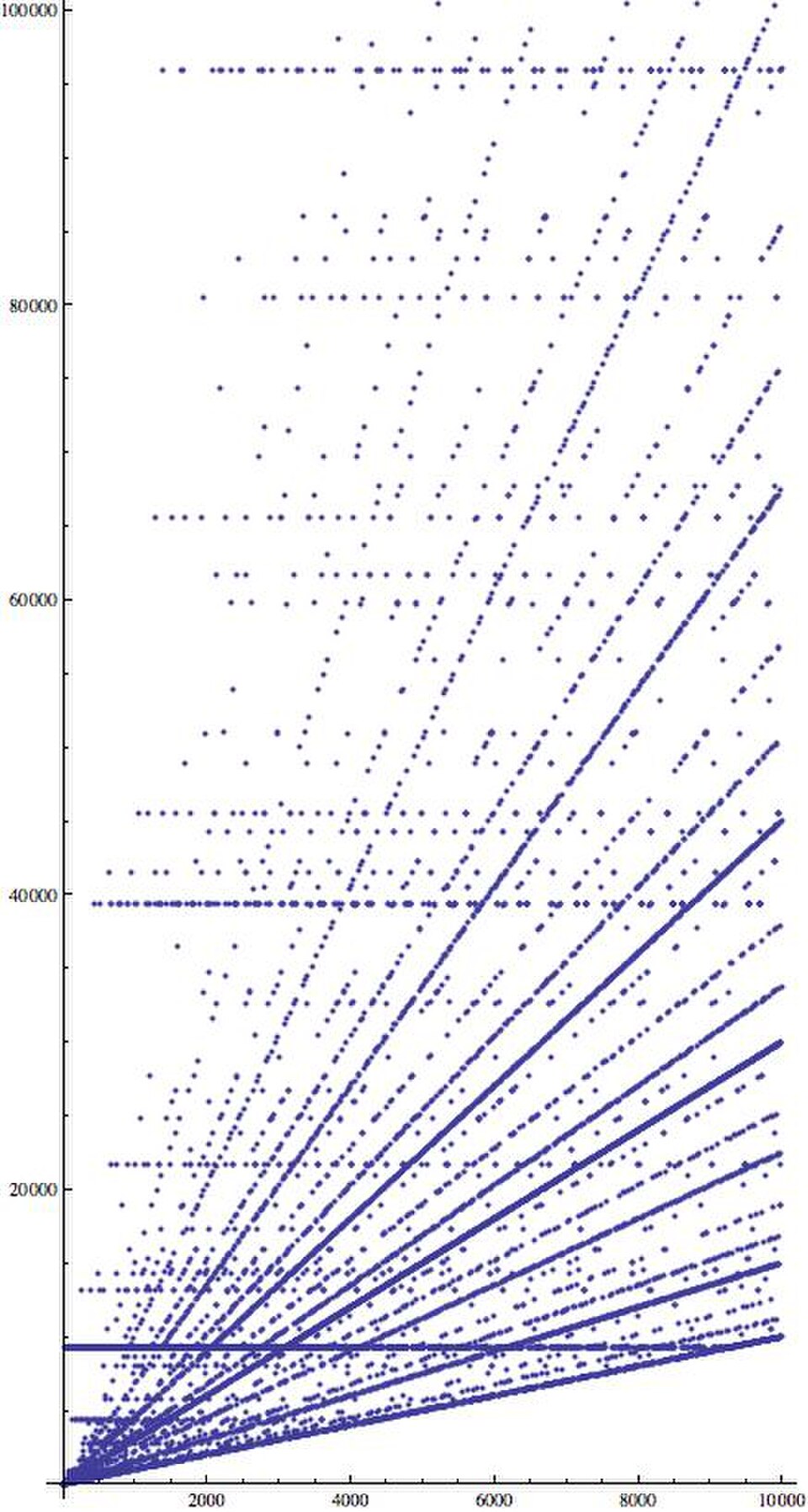
Numbers from 1 to 9999 and their corresponding total stopping timeHistogram of total stopping times for the numbers 1 to 108. Total stopping time is on the Histogram of total stopping times for the numbers 1 to 109. Total stopping time is on the Iteration time for inputs of 2 to 107.Total stopping time of numbers up to 250, 1000, 4000, 20000, 100000, 500000
Consider the following operation on an arbitrary positive integer:
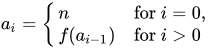
Now form a sequence by performing this operation repeatedly, beginning with any positive integer, and taking the result at each step as the input at the next.
In notation: 0 \\end{cases}" 0\end{cases (that is: , there is some with .
If the conjecture is false, it can only be because there is some starting number which gives rise to a sequence that does not contain 1. Such a sequence would either enter a repeating cycle that excludes 1, or increase without bound. No such sequence has been found.
The smallest This definition yields smaller values for the stopping time and total stopping time without changing the overall dynamics of the process.
These numbers are the lowest ones with the indicated step count, but not necessarily the only ones below the given limit. As an example, powers of two, since
Directed graph showing the orbits of the first 1000 numbers.
The
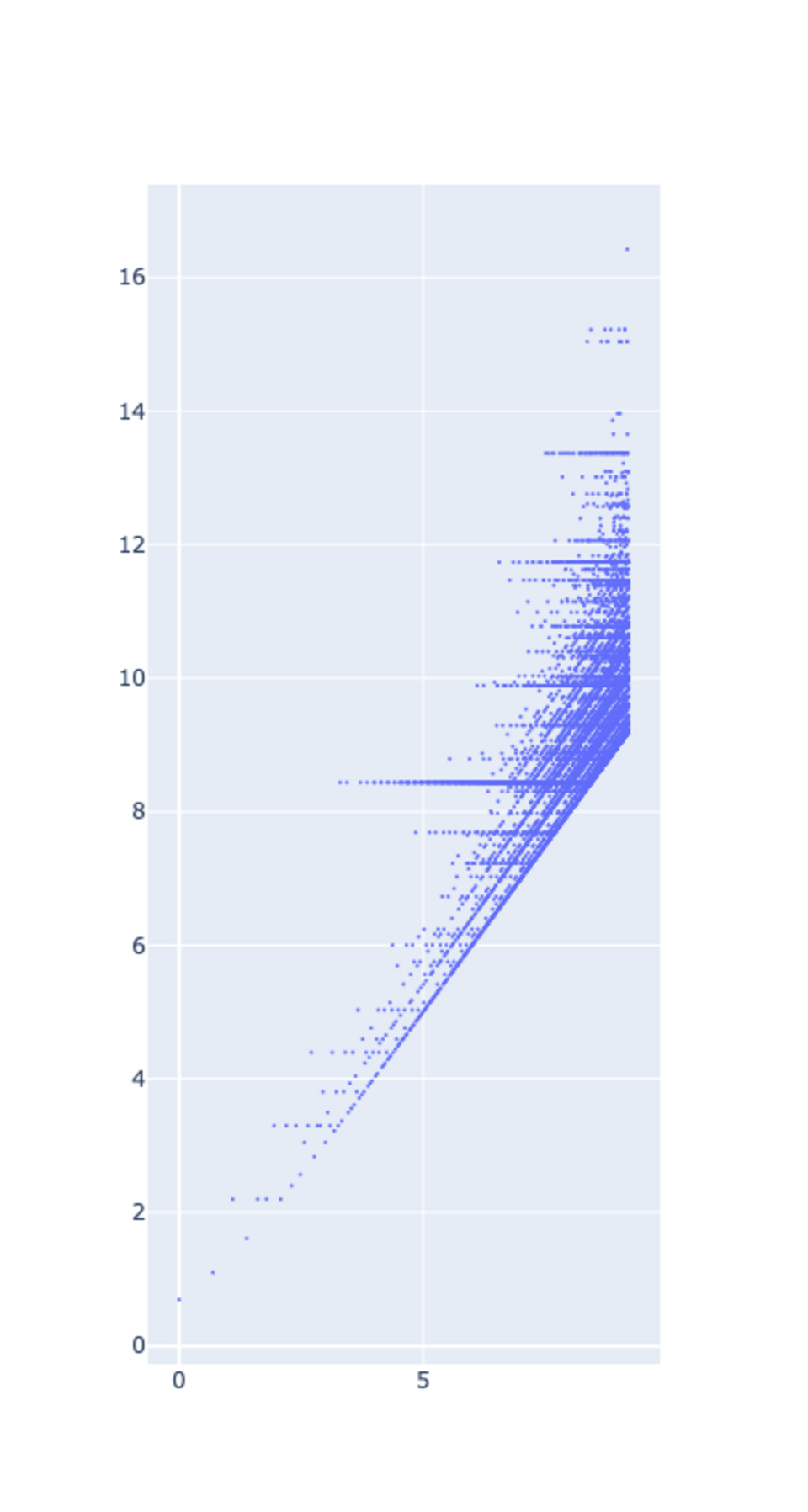
The same plot as the previous one but on log scale, so all
The tree of all the numbers having fewer than 20 steps.
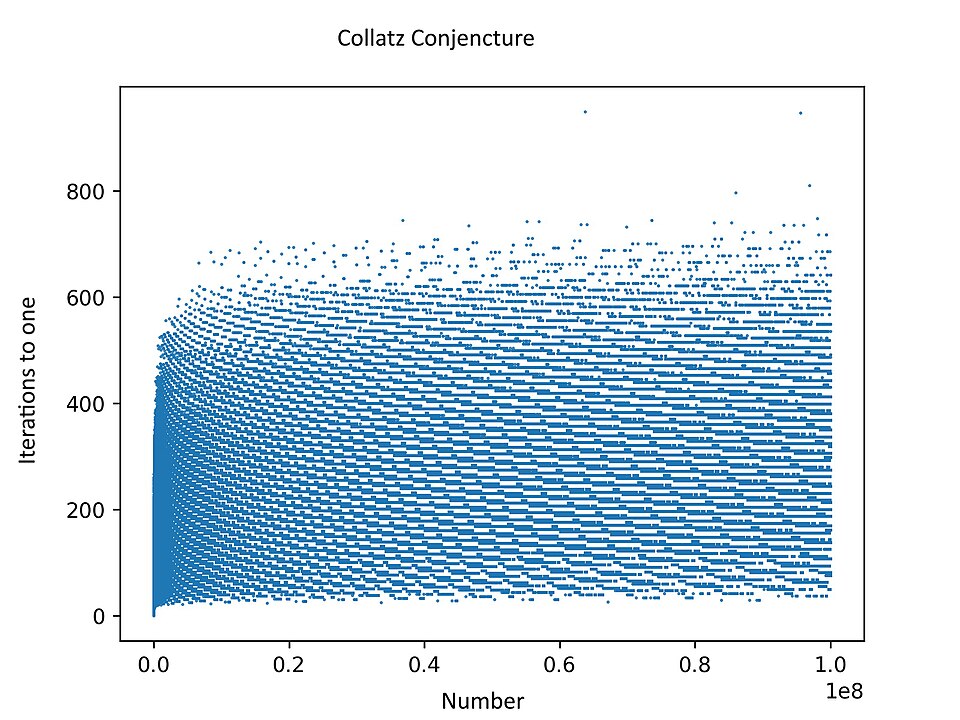
The number of iterations it takes to get to one for the first 100 million numbers.
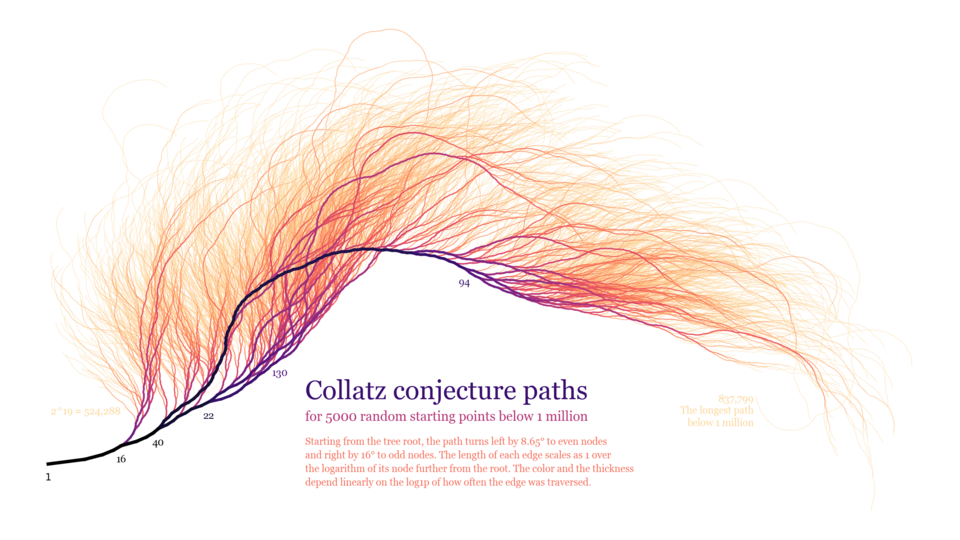
Collatz conjecture paths for 5000 random starting points below 1 million.
Supporting arguments
Although the conjecture has not been proven, most mathematicianscounterexamples may be found when considering very large positive integers, as in the case of the disproven Pólya conjecture and Mertens conjecture.
However, such verifications may have other implications. Certain constraints on any non-trivial cycle, such as lower bounds on the length of the cycle, can be proven based on the value of the lowest term in the cycle. Therefore, computer searches to rule out cycles that have a small lowest term can strengthen these constraints.
A probabilistic heuristic
If one considers only the odd numbers in the sequence generated by the Collatz process, then each odd number is on average 3/4 of the previous one. (More precisely, the geometric mean of the ratios of outcomes is 2-adic extension of the Collatz process has two division steps for every multiplication step for almost all 2-adic starting values.)
Stopping times
As proven by Riho Terras, almost every positive integer has a finite stopping time. In other words, almost every Collatz sequence reaches a point that is strictly below its initial value. The proof is based on the distribution of parity vectors and uses the central limit theorem.
In 2019, Terence Tao improved this result by showing, using logarithmic density, that almost all (in the sense of logarithmic density) Collatz orbits descend below any given function of the starting point, provided that this function diverges to infinity, no matter how slowly. Responding to this work, Quanta Magazine wrote that Tao "came away with one of the most significant results on the Collatz conjecture in decades".
Lower bounds
In a computer-aided proof, Krasikov and Lagarias showed that the number of integers in the interval A cycle is a sequence where simple continued fraction expansion of The first 21 levels of the Collatz graph generated in bottom-up fashion. The graph includes all numbers with an orbit length of 21 or less.
There is another approach to prove the conjecture, which considers the bottom-up method of growing the so-called Collatz graph, a graph defined by the inverse relation
So, instead of proving that all positive integers eventually lead to 1, we can try to prove that 1 leads backwards to all positive integers. For any integer if and only iftree for positive integers except for the 1–2–4 loop (the inverse of the 4–2–1 loop of the unaltered function Statement of the problem section of this article).
When the relation
For any integer power of 2 that divides remainder). The resulting function odd numbers to odd numbers. Now suppose that for some odd number binary, the number stringsrepetends of abstract machine that handles strings of bits. The machine will perform the following three steps on any odd number until only one 1 remains:
Append binary as
If
Hailstone sequences can be computed by the 2-tag system with production rules
The generalized Collatz conjecture is the assertion that every integer, under iteration by 2-adic integers, which contains the ring of rationals with odd denominators as a subring.
When using the "shortcut" definition of the Collatz map, it is known that any periodic parity sequence is generated by exactly one rational. Conversely, it is conjectured that every rational with an odd denominator has an eventually cyclic parity sequence (Periodicity Conjecture).
If a parity cycle has length
For example, the parity cycle as the latter leads to the rational cycle
Any cyclic permutation of
For a one-to-one correspondence, a parity cycle should be irreducible, that is, not partitionable into identical sub-cycles. As an illustration of this, the parity cycle
2-adic extension
The function is well-defined on the ring of 2-adic integers, where it is continuous and measure-preserving with respect to the 2-adic measure. Moreover, its dynamics is known to be ergodic.
Define the parity vector function as
The function isometry. Consequently, every infinite parity sequence occurs for exactly one 2-adic integer, so that almost all trajectories are acyclic in .
An equivalent formulation of the Collatz conjecture is that
Iterating on real or complex numbersCobweb plot of the orbit 10 → 5 → 8 → 4 → 2 → 1 → ... in an extension of the Collatz map to the real line.
The Collatz map can be extended to the real line by choosing any function which evaluates to when is an even integer, and to either or (for the "shortcut" version) when is an odd integer. This is called an interpolating function. A simple way to do this is to pick two functions and , where:
and use them as switches for our desired values:
.
One such choice is and . The iterations of this map lead to a dynamical system, further investigated by Marc Chamberland. He showed that the conjecture does not hold for positive real numbers since there are infinitely many fixed points, as well as orbits escaping monotonically to infinity. The function has two attracting cycles of period : and . Moreover, the set of unbounded orbits is conjectured to be of measure.
Letherman, Schleicher, and Wood extended the study to the complex plane. They used Chamberland's function for complex sine and cosine and added the extra term , where is any entire function. Since this expression evaluates to zero for real integers, the extended function
is an interpolation of the Collatz map to the complex plane. The reason for adding the extra term is to make all integers critical points of . With this, they show that no integer is in a Baker domain, which implies that any integer is either eventually periodic or belongs to a wandering domain. They conjectured that the latter is not the case, which would make all integer orbits finite.
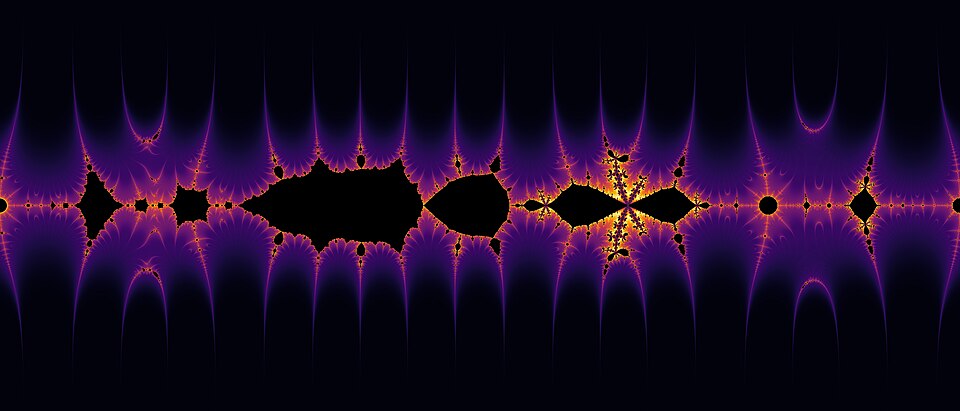
A Collatz fractal centered at the origin, with real parts from –5 to 5.
Most of the points have orbits that diverge to infinity. Coloring these points based on how fast they diverge produces the image on the left, for . The inner black regions and the outer region are the Fatou components, and the boundary between them is the Julia set of , which forms a fractal pattern, sometimes called a "Collatz fractal".
Julia set of the exponential interpolation.
There are many other ways to define a complex interpolating function, such as using the complex exponential instead of sine and cosine:
,
which exhibit different dynamics. In this case, for instance, if , then . The corresponding Julia set, shown on the right, consists of uncountably many curves, called hairs, or rays.
As a parity sequence above gives a way to speed up simulation of the sequence. To jump ahead precomputation and storage to speed up the resulting calculation by a factor of space–time tradeoff.
Modular restrictions
For the special purpose of searching for a counterexample to the Collatz conjecture, this precomputation leads to an even more important acceleration, used by Tomás Oliveira e Silva in his computational confirmations of the Collatz conjecture up to large values ofA075677 in the OEIS).
Some properties of the Syracuse function are:
For all function iteration notation.)
For all odd John Horton Conway proved that a natural generalization of the Collatz problem is algorithmically undecidable.
Specifically, he considered functions of the form where halting problem in this way.
Closer to the Collatz problem is the following universally quantified problem:
The Collatz and related conjectures are often used when studying computational complexity. The connection is made through the busy beaver function, where BB(n) is the maximum number of steps taken by any n-state Turing machine that halts. There is a 15-state Turing machine that halts if and only if the following conjecture by Paul Erdős (closely related to the Collatz conjecture) is false: for all n > 8 there is at least one digit 2 in the base 3 representation of 2n. Hence if BB(15) was known, and this machine did not stop in that number of steps, it would be known to run forever and hence no counterexamples exist (which proves the conjecture true). This is a completely impractical way to settle the conjecture; instead it is used to suggest that BB(15) will be very hard to compute, at least as difficult as settling this Collatz-like conjecture.
In 2024, a six-state machine was found for which determining whether it halts involves solving a Collatz-like problem called the antihydra problem. As proofs of even simple conjectures of this nature are not currently known, this suggests that BB(6) will be very hard to compute.
 Worldlex Wiki