 Worldlex Wiki
 arcade system board developed by Capcom that ran game software stored on removable daughterboards. More than two dozen arcade titles were released for CPS-1, before Capcom shifted game development over to its successor, the CP System II. Technical support for the CPS-1 ended on March 31, 2015.
The CP System is best known for its many beat 'em up titles such as Dynasty Wars, Final Fight, The King of Dragons, Captain Commando, Knights of the Round, Warriors of Fate, Cadillacs and Dinosaurs, and The Punisher, as well as fighting games such as Street Fighter II and Muscle Bomber.
Kenzo Tsujimoto came up with the concept inspired by the success of the Nintendo Entertainment System (NES), known domestically as the Family Computer (Famicom). He saw the rise of home video games as competition for the arcades, and stated that "the only way we can make money is to give people twice what they can get at home". After a number of arcade game boards designed to run only one game, Capcom also embarked upon a project to produce a system board that could be used to run multiple games, in order to reduce hardware costs and make the system more appealing to arcade operators.Capcom developed the hardware for about two-and-a-half years, during which time they developed two custom microchips known as the "CPS Super Chips", which were equivalent to the power of ten normal arcade boards at the time. The two chips cost around £5,500,000 or bootleg versions of its games. In particular, there were so many bootleg versions of Street Fighter II that they were more common in some countries than the official version. This problem was virtually eliminated by Capcom in the later CP System II.Neo Geo AES.
Capcom ceased production of the CP System hardware on May 11, 1995; however, new software continued to be released for the hardware as late as 2000. Capcom ended technical support for the CP System hardware and its games on March 31, 2015.
Technical specifications
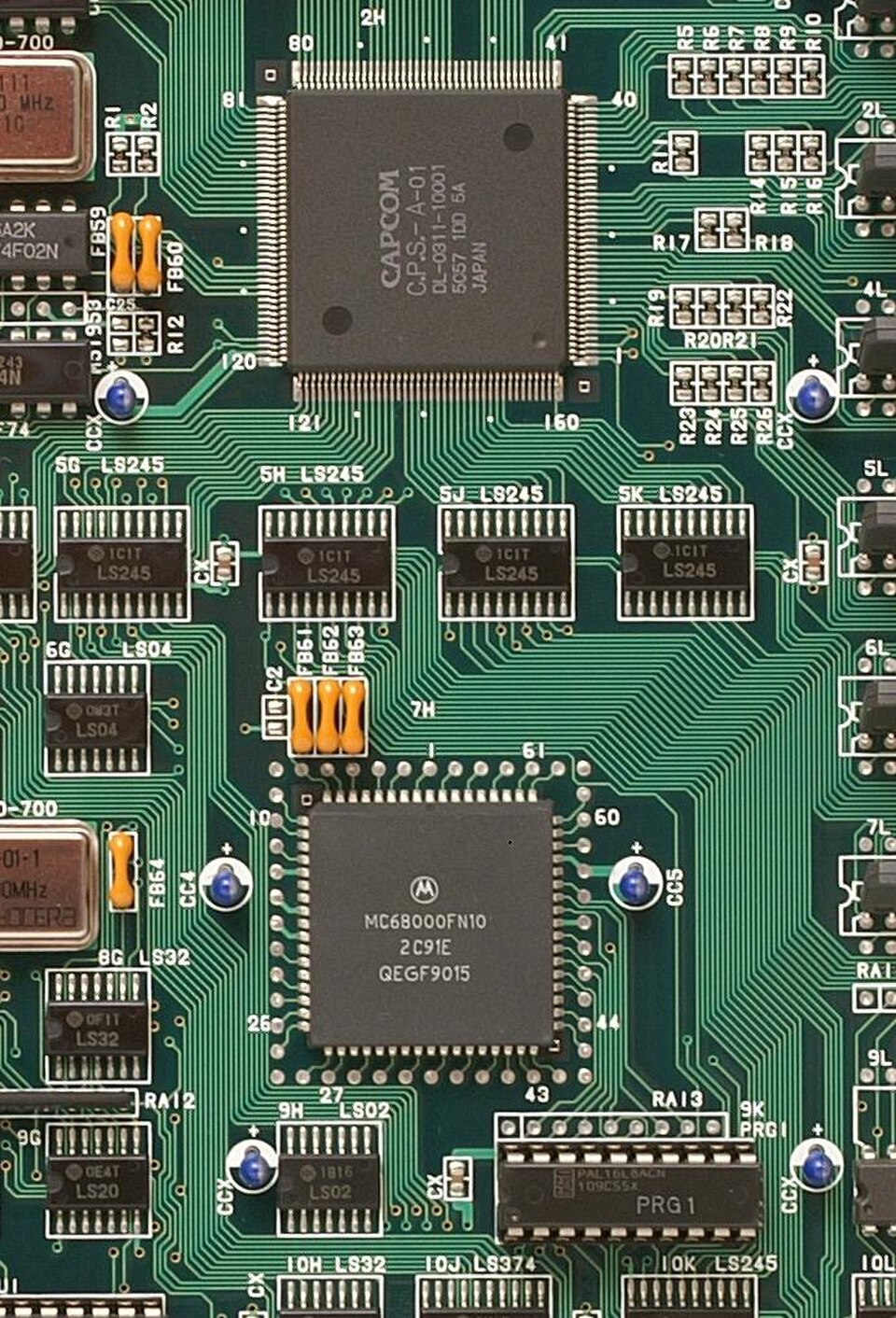
- CPU:
- Primary: Motorola 68000 @ 10MHz (some later boards 12MHz)
- Secondary: Zilog Z80 @ 3.579MHz
- Co-processors: 2x CPS Super Chip
- Sound chips:
- Display
- Resolution: Raster, 384×224 @ 59.6294Hz
- Color depth: 16-bit (12-bit RGB with 4-bit brightness value)
- Colors available: 65,536
- Onscreen colors: 4096 (192 global palettes with 16 colors each)
- Sprites:
- Simultaneously displayable: 256 (per scanlines)
- Sizes: 16×16, max. 16 colors (15 unique + 1 transparent)
- Vertical and horizontal flipping capability
- Tiles: Sizes 8×8, 16×16, 32×32 with 16 colors (15 unique + 1 transparent)
- Tile maps: 3 maps, 512×512, 1024×1024, 2048×2048 pixel
- RAM:
List of games (32 games)
| English title | Release date | Developer | Japanese title | Genre |
|---|---|---|---|---|
| Forgotten Worlds | May 13, 1988 | Capcom | Lost Worlds(ロストワールド) | Shoot 'em up |
| Ghouls'n Ghosts | December 1988 | Capcom | Daimakaimura(大魔界村) | Platform |
| Strider | March 1989 | Capcom | Strider Hiryū(ストライダー飛竜) | Platformer |
| Dynasty Wars | April 1989 | Capcom | Tenchi o Kurau(天地を喰らう) | Beat 'em up |
| Willow | June 1989 | Capcom | Willow(ウィロー) | Platform |
| U.N. Squadron | August 1989 | Capcom | Area 88(エリア88) | Shoot 'em up |
| Final Fight | December 1, 1989 | Capcom | Final Fight(ファイナルファイト) | Beat 'em up |
| 1941: Counter Attack | February 1990 | Capcom | 1941(1941) | Shoot 'em up |
| Mercs | March 2, 1990 | Capcom | Senjō no Ōkami II(戦場の狼II) | Run and gun |
| Mega Twins | June 19, 1990 | Capcom | Chiki Chiki Boys(チキチキボーイズ) | Platform |
| Magic Sword - Heroic Fantasy | June 23, 1990 | Capcom | Magic Sword(マジックソード) | Platform |
| Carrier Air Wing | October 9, 1990 | Capcom | U.S. Navy(U.S.NAVY) | Shoot 'em up |
| Nemo | November 20, 1990 | Capcom | Nemo(ニモ) | Platformer |
| Street Fighter II: The World Warrior | February 6, 1991 | Capcom | Street Fighter II: The World Warrior(ストリートファイターII -The World Warrior-) | Head-to-head fighting |
| Three Wonders | May 20, 1991 | Capcom | Wonder 3(ワンダー3) | Multi-game |
| The King of Dragons | July 11, 1991 | Capcom | The King of Dragons(ザ・キングオブドラゴンズ) | Beat 'em up |
| Captain Commando | September 28, 1991 | Capcom | Captain Commando(キャプテンコマンドー) | Beat 'em up |
| Knights of the Round | November 27, 1991 | Capcom | Knights of the Round(ナイツオブザラウンド) | Beat 'em up |
| Street Fighter II: Champion Edition | March 13, 1992 | Capcom | Street Fighter II (Dash): Champion Edition(ストリートファイターIIダッシュ -Champion Edition-) | Head-to-head fighting |
| Adventure Quiz: Capcom World 2 | June 11, 1992 | Capcom | Adventure Quiz Capcom World 2(アドベンチャークイズカプコンワールド2) | Quiz game |
| Varth: Operation Thunderstorm | June 12, 1992 | Capcom | Varth: Operation Thunderstorm(バース -オペレーションサンダーストーム-) | Shoot 'em up |
| Quiz & Dragons: Capcom Quiz Game | July 1, 1992 | Capcom | Quiz & Dragons(クイズ&ドラゴンズ) | Quiz game |
| Street Fighter II: Hyper Fighting | December 9, 1992 | Capcom | Street Fighter II (Dash) Turbo: Hyper Fighting(ストリートファイターIIダッシュターボ -Hyper Fighting-) | Head-to-head fighting |
| Pokonyan! Balloon | March 22, 1994 | Capcom | Pokonyan! Balloon(ポコニャン!バルーン) | Kiddie ride |
| Ken Sei Mogura: Street Fighter II | April 18, 1994 | Capcom/Togo/Sigma | Ken Sei Mogura(拳聖土竜) | Whack a mole |
| Pnickies | June 8, 1994 | Capcom/Compile | Pnickies(ぷにっきいず) | Puzzle |
| Quiz Tonosama no Yabō 2: Zenkoku-ban | January 23, 1995 | Capcom | Quiz Tonosama no Yabō 2: Zenkoku-ban(クイズ 殿様の野望2 全国版) | Quiz game |
| Pang! 3 | May 11, 1995 | Capcom/Mitchell Corporation | Platformer | |
| Mega Man: The Power Battle(CPS-1 version) | October 6, 1995 | Capcom | Rockman: The Power Battle(ロックマン ザ・パワーバトル) | Action |
| Magical Pumpkin | October 31, 1995 | Capcom | Magical Pumpkin(マジカルパンプキン) | Kiddie ride |
| Ganbare! Marine Kun | April 11, 2000 | Capcom | Ganbare! Marine Kun(がんばれ!マリン君) | Redemption |
| Gulun.Pa! | Unreleased | Capcom | Gulun.Pa!(グルンパ!) | Puzzle |
CP System Dash
To combat piracy, "suicide batteries" were implemented, which power the volatile RAM which contained the manual configuration of the display hardware registers, as well as the priorities registers. If the batteries' voltage drops below +2V, the registers manually defined in factory by Capcom in RAM would be lost, and the PPU would no longer have access to the hardware specific register set on the game used. This renders the game inoperable, necessitating the operator sending the board to Capcom to be fixed at their own expense. Unlike the CP System II, the CP System Dash sound ROMs were encrypted using "Kabuki" Z80s. The CP System Dash 68000 code is not encrypted at all.
List of games (5 games)
All five games are developed and published by Capcom.
| English title | Release date | Japanese title | Genre |
|---|---|---|---|
| Warriors of FateSangokushi II(Asia) | October 2, 1992 | Tenchi o Kurau II: Sekiheki no Tatakai(天地を喰らう2・赤壁の戦い) | Beat 'em up |
| Cadillacs and Dinosaurs | February 1, 1993 | Cadillacs Kyōryū Shinseiki(キャディラックス 恐竜新世紀) | Beat 'em up |
| The Punisher | April 22, 1993 | The Punisher(パニッシャー) | Beat 'em up |
| Saturday Night Slam Masters | July 13, 1993 | Muscle Bomber: The Body Explosion(マッスルボマー -The Body Explosion-) | Sports game |
| Muscle Bomber Duo: Ultimate Team Battle | December 6, 1993 | Muscle Bomber Duo: Heat Up Warriors(マッスルボマーDUO -Heat Up Warriors-) | Sports game |
Capcom Power System Changer
A home video game console version of the CP System, the Capcom Power System Changer (or CPS Changer), was released in late 1994 in Japan to compete with SNK's Neo Geo AES. It was Capcom's attempt at selling their arcade games in a home-friendly format.
The CPS Changer was sold as a package deal containing the console itself, one CPS Fighter joystick controller, and Street Fighter II (Dash) Turbo for 39,800 yen. Additional games were sold for about 20,000 yen. Upon its release in November 1994, Capcom initially manufactured only 1,000 units in Japan.
The CPS Changer's adapter was basically an encased SuperGun (i.e. Television JAMMA adapter), and was compatible with most JAMMA standard PCBs. Capcom's "protection" against people using the CPS Changer on other arcade boards was the physical shape of the device. On a normal JAMMA PCB, it would not attach firmly and would lean at odd angles, but it would work. The CPS Changer has outputs for composite video, S-video and line-level mono audio. The CPS Changer also featured Super Famicom/Super NES controller ports, allowing the use of all Super Famicom/Super NES controllers, including their own six-button joystick, the "CPS Fighter".
All of the CPS Changer games used the CP System arcade hardware. The CPS Changer games were simply arcade PCBs in a special plastic shell suitable for home use; this concept had already been done with the CP System II hardware a year prior. The plastic shells are identical to that used in CP System Dash games. Some CPS-1 games were changed slightly for home release, sometimes including debugging features or other easter eggs.backported version of Street Fighter Zero (also known as Street Fighter Alpha) in 1995, originally released for the CP System II hardware. This port, released at a premium 35,000 yen in 1996, was downgraded slightly for the system's less capable hardware: it ran at a slightly slower frame rate, had a lower color depth and palette,sampled at a lower rate.
The CPS Changer version of Street Fighter Zero also had a limited release overseas in the arcades for publicity testing purposes (being released as Street Fighter Alpha for those regions) where it was distributed as a standard CP System release, especially to those who couldn't afford the upgrade to the CP System II hardware. Another CP System II game that was backported around the same timeframe, Rockman: The Power Battle (also known as Mega Man: The Power Battle), also received similar changes when it was ported to the CP System hardware (but not the CPS Changer, as no new releases for it were made after Street Fighter Zero), and it too had limited releases in the arcades much like the publicity test versions of Street Fighter Zero for the CPS Changer.
List of games (11 games)
All 11 games were developed and published by Capcom. Most games on this list ran on CP System hardware, while some ran on CP System Dash hardware.
| English title | Release date | Japanese title | Genre |
|---|---|---|---|
| Warriors of FateSangokushi II(Asia) | 1994 | Tenchi o Kurau II: Sekiheki no Tatakai(天地を喰らう2・赤壁の戦い) | Beat 'em up |
| Capcom World 2: Adventure Quiz | 1994 | Adventure Quiz Capcom World 2(アドベンチャークイズカプコンワールド2) | Quiz game |
| Captain Commando | 1995 | Captain Commando(キャプテンコマンドー) | Beat 'em up |
| Final Fight | 1994 | Final Fight(ファイナルファイト) | Beat 'em up |
| Knights of the Round | 1995 | Knights of the Round(ナイツオブザラウンド) | Beat 'em up |
| Muscle Bomber Duo: Ultimate Team Battle | 1995 | Muscle Bomber Duo: Heat Up Warriors(マッスルボマーDUO -Heat Up Warriors-) | Sports game |
| Saturday Night Slam Masters | 1994 | Muscle Bomber: The Body Explosion(マッスルボマー -The Body Explosion-) | Sports game |
| Street Fighter II: Champion Edition | 1994 | Street Fighter II Dash: Champion Edition(ストリートファイターIIダッシュ -Champion Edition-) | Versus Fighting |
| Street Fighter II Turbo: Hyper Fighting | 1994, pack-in | Street Fighter II Dash Turbo: Hyper Fighting(ストリートファイターIIダッシュターボ -Hyper Fighting-) | Versus Fighting |
| Street Fighter Alpha | 1995 | Street Fighter Zero(ストリートファイターZERO) | Versus Fighting |
| The King of Dragons | 1995 | The King of Dragons(ザ・キングオブドラゴンズ) | Beat 'em up |